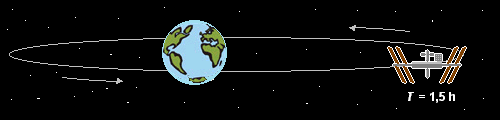
La Station Spatiale Internationale (ISS - International Space Station) fait un tour de la
Terre toutes les 1,5 heures. Déterminer:
a) Le période de rotation en minutes et en secondes;
b) La fréquence de rotation de la station autour de la Terre en hertz.
Donnée du problème:
- Période de rotation de la station autour de la Terre: T = 1,5 h;
Schéma du problème:
Solution:
a) En convertissant la période de rotation donnée dans le problème en heures en minutes
\[
\begin{gather}
T=\left(1,5\;\mathrm{\cancel h}\right)\times\left(\frac{60\;\mathrm{min}}{1\;\mathrm{\cancel{h}}}\right)
\end{gather}
\]
\[
\begin{gather}
\bbox[background:#FFCCCC; padding:10px; border-radius:10px;]
{T=90\;\mathrm{min}}
\end{gather}
\]
La période en secondes sera de
\[
\begin{gather}
T=\left(1,5\;\mathrm{\cancel h}\right)\times\left(\frac{3600\;\mathrm s}{1\;\mathrm{\cancel h}}\right)
\end{gather}
\]
\[
\begin{gather}
\bbox[background:#FFCCCC; padding:10px; border-radius:10px;]
{T=5400\;\mathrm{s}}
\end{gather}
\]
Remarque: Pour obtenir la période de rotation en secondes, nous pourrions
également prendre le résultat obtenu en minutes et le multiplier par 60,
\( T=\left(90\;\mathrm{\cancel{min}}\right)\times\left(\frac{60\;\mathrm s}{1\;\mathrm{\cancel{min}}}\right)=5400\;\mathrm s \) ,
pour obtenir le même résultat.
b) Pour obtenir la fréquence en hertz, nous utilisons la valeur de la période en secondes, obtenue dans
l'article précédent, et calculons
\[
\begin{gather}
\bbox[background:#99CCFF; padding:10px; border-radius:10px;]
{f=\frac{1}{T}}
\end{gather}
\]
\[
\begin{gather}
f=\frac{1}{5400\;\mathrm s}
\end{gather}
\]
\[
\begin{gather}
\bbox[background:#FFCCCC; padding:10px; border-radius:10px;]
{f=0,000185=1,85\times 10^{-4}\;\mathrm{Hz}}
\end{gather}
\]
 DE
DE
 EN
EN
 ES
ES
 PT-BR
PT-BR