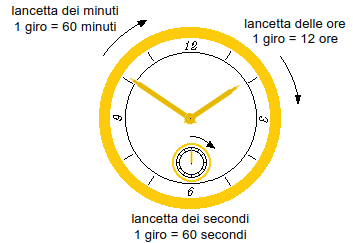
In un tradizionale orologio con lancette determinare il periodo e la frequenza di rotazione delle lancette delle ore,
dei minuti e dei secondi (risposte in secondi e hertz).
Schema del problema:
Soluzione
La lancetta delle ore compie un giro in 12 h, il suo periodo sarà
\[
\begin{gather}
T=\left(12\;\mathrm{\cancel h}\right)\times\left(\frac{3600\;\mathrm s}{1\;\mathrm{\cancel h}}\right)
\end{gather}
\]
\[
\begin{gather}
\bbox[background:#FFCCCC; padding:10px; border-radius:10px;]
{T=43200\;\mathrm s}
\end{gather}
\]
la frequenza in funzione del periodo è data da
\[
\begin{gather}
\bbox[background:#99CCFF; padding:10px; border-radius:10px;]
{f=\frac{1}{T}} \tag{I}
\end{gather}
\]
\[
\begin{gather}
f=\frac{1}{43200\;\mathrm s}
\end{gather}
\]
\[
\begin{gather}
\bbox[background:#FFCCCC; padding:10px; border-radius:10px;]
{f\approx 0,000023=2,3\times 10^{-5}\;\mathrm{Hz}}
\end{gather}
\]
La lancetta dei minuti compie un giro in 60 min, il suo periodo sarà
\[
\begin{gather}
T=\left(60\;\mathrm{\cancel{min}}\right)\times\left(\frac{60\;\mathrm s}{1\;\mathrm{\cancel{min}}}\right)
\end{gather}
\]
\[
\begin{gather}
\bbox[background:#FFCCCC; padding:10px; border-radius:10px;]
{T=3600\;\mathrm s}
\end{gather}
\]
per la frequenza, applicando l'equazione (I)
\[
\begin{gather}
f=\frac{1}{3600\;\mathrm s}
\end{gather}
\]
\[
\begin{gather}
\bbox[background:#FFCCCC; padding:10px; border-radius:10px;]
{f\approx 0,00028=2,8\times 10^{-4}\;\mathrm{Hz}}
\end{gather}
\]
La lancetta dei secondi compie un giro in 60 s, il suo periodo sarà
\[
\begin{gather}
\bbox[background:#FFCCCC; padding:10px; border-radius:10px;]
{T=60\;\mathrm s}
\end{gather}
\]
per la frequenza, applicando l'equazione (I)
\[
\begin{gather}
f=\frac{1}{60\;\mathrm s}
\end{gather}
\]
\[
\begin{gather}
\bbox[background:#FFCCCC; padding:10px; border-radius:10px;]
{f\approx 0,017=1,7\times 10^{-2}\;\mathrm{Hz}}
\end{gather}
\]
 DE
DE
 EN
EN
 ES
ES
 FR
FR
 PT-BR
PT-BR