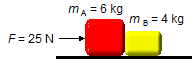


Two bodies of masses ma = 6 kg and mb = 4 kg are on a frictionless
horizontal surface. A horizontal force of constant magnitude equal to 25 N is applied to push the two
bodies. Find the acceleration acquired by the set and the magnitude of the contact force between the
bodies.
Problem data:
- Mass of body A: ma = 6 kg;
- Mass of body B: mb = 4 kg;
- Force applied to the system: F = 25 N.
Problem diagram:
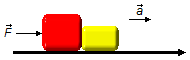
We choose a frame of reference oriented to the right in the same direction as the applied force
\( \vec F \)
and produce an acceleration a on the system.
Drawing a Free-Body Diagram for each body
-
Body A:
-
Horizontal direction:
- \( \vec F \) : force applied to the body;
- \( -\vec f \) : reaction force of body B on A.
-
Vertical direction:
- \( {\vec N}_a \) : normal reaction force of the surface on the body;
- \( {\vec W}_a \) : weight of body A.
-
Body B:
-
Horizontal direction:
- \( \vec f \): action force of body A on B.
-
Vertical direction:
- \( {\vec N}_b \): normal reaction force of the surface on the body;
- \( {\vec W}_b \): weight of body B.
Solution:
Applying Newton's Second Law
\[
\begin{gather}
\bbox[#99CCFF,10px]
{\vec F=m\vec a}
\end{gather}
\]
In the vertical direction, there is no motion, the normal force and weight cancel each other out.
In the horizontal direction
\[
\begin{gather}
F-f=m_aa \tag{I}
\end{gather}
\]
In the vertical direction, there is no motion, the normal force and weight cancel each other out.
In the horizontal direction
\[
\begin{gather}
{f=m_ba} \tag{II}
\end{gather}
\]
Equations (I) and (II) can be written as a system of linear equations with two variables
(f and a)
\[
\begin{gather}
\left\{
\begin{array}{rr}
F-f&=m_aa \\
f&=m_ba
\end{array}
\right.
\end{gather}
\]
substituting equation (II) into equation (I), we have the acceleration
\[
\begin{gather}
F-m_ba=m_aa \\[5pt]
F=a(m_a+m_b) \\[5pt]
a=\frac{F}{m_a+m_b} \\[5pt]
a=\frac{25\;\mathrm N}{(6\;\mathrm kg)+(4\;\mathrm kg)}\\[5pt]
a=\frac{25\;\mathrm{\frac{\cancel{kg}.m}{s^2}}}{10\;\mathrm{\cancel{kg}}}
\end{gather}
\]
\[
\begin{gather}
\bbox[#FFCCCC,10px]
{a=2.5\;\mathrm{m/s^2}}
\end{gather}
\]
Note: Since the two bodies form a set subjected to the same force, both have the same
acceleration. The system behaves as if it were a single body with total mass given by the sum of the
masses of the two bodies, A and B.
Substituting the acceleration found in equation (II), we have the force of contact between the bodies
\[
\begin{gather}
f=(4\;\mathrm{kg})\left(2.5\;\mathrm{\frac{m}{s^2}}\right)
\end{gather}
\]
\[
\begin{gather}
\bbox[#FFCCCC,10px]
{f=10\;\mathrm N}
\end{gather}
\]
Note: In the same way, we could substitute the acceleration in the equation (I) to obtain the
contact force
\[
\begin{gather}
(25\;\mathrm N)-f=(6\;\mathrm{kg})\left(2.5\;\mathrm{\frac{m}{s^2}}\right)\Rightarrow (25\;\mathrm N)-f=15\;\mathrm N\Rightarrow f=10\;\mathrm N
\end{gather}
\]