From the top of a 100 m tall building is relesead at rest, a 900 g mass brick under the action of
gravitational force. Find:
a) The speed of the brick when touching the floor;
b) The momentum of brick by touching the floor;
c) The impulse of force acting on brick during fall.
Problem data:
- Fall height: S = 100 m;
- Mass of brick: m = 900 g;
- Initial speed of brick: v0 = 0;
- Acceleration due to gravity: g = 9.8 m/s2.
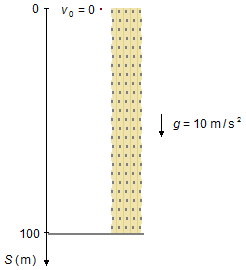
Problem diagram:
We choose a frame of reference pointing downward at the top of the building. As the brick is at rest, its
initial speed is zero, v0 = 0, its initial position is also zero,
S0 = 0, and the acceleration due to gravity is in the same direction as the frame
of reference (Figure 1).
Solution:
First, we must convert the mass of brick given in grams (g) to kilograms (kg) used in the
International System of Units (SI)
\[
\begin{gather}
m=900\;\mathrm{\cancel g}\times\frac{1\;\mathrm{kg}}{1000\;\mathrm{\cancel g}}=0.9\;\mathrm{kg}
\end{gather}
\]
a) The brick is in free fall under the action of acceleration due to gravity
\[
\begin{gather}
\bbox[background:#99CCFF; padding:10px; border-radius:10px;]
{S=S_0+v_0t+\frac{a}{2}t^2}
\end{gather}
\]
the acceleration of the motion is the acceleration due to gravity, a = g, and substituting the values
\[
\begin{gather}
S=S_0+v_0t+\frac{g}{2}t^2 \\[5pt]
100=0+0\times t+\frac{9.8}{2}t^2 \\[5pt]
100=4.9t^2 \\[5pt]
t^2=\frac{100}{4.9} \\[5pt]
t=\sqrt{20.4\;} \\[5pt]
t\approx 4.5\;\mathrm{s}
\end{gather}
\]
This is the interval of time for the brick to reach the ground. Velocity as a function of time is given by
\[
\begin{gather}
\bbox[background:#99CCFF; padding:10px; border-radius:10px;]
{v=v_0+at}
\end{gather}
\]
substituting the interval of time found, a = g, and the initial speed equal to zero
\[
\begin{gather}
v=v_0+gt \\[5pt]
v=0+9.8\times 4.5
\end{gather}
\]
\[
\begin{gather}
\bbox[background:#FFCCCC; padding:10px; border-radius:10px;]
{v\approx 44.1\;\mathrm{m/s}}
\end{gather}
\]
b) The momentum is given by
\[
\begin{gather}
\bbox[background:#99CCFF; padding:10px; border-radius:10px;]
{p=mv}
\end{gather}
\]
substituting the mass given to the brick and the speed, calculated in the previous item
\[
\begin{gather}
p=(0.9\;\mathrm{kg})\times\left(44.1\;\mathrm{\frac{m}{s}}\right)
\end{gather}
\]
\[
\begin{gather}
\bbox[background:#FFCCCC; padding:10px; border-radius:10px;]
{p=39.7\;\mathrm{kg.m/s}}
\end{gather}
\]
c) The impulse of a force is given by
\[
\begin{gather}
\bbox[background:#99CCFF; padding:10px; border-radius:10px;]
{I=F\Delta t}
\end{gather}
\]
the weight is the only force that acts in the brick, given by
\[
\begin{gather}
\bbox[background:#99CCFF; padding:10px; border-radius:10px;]
{W=mg}
\end{gather}
\]
using the interval of time calculated in item (a)
\[
\begin{gather}
I=W\Delta t \\[5pt]
I=mg\Delta t \\[5pt]
I=0.9\times 9.8\times 4.5
\end{gather}
\]
\[
\begin{gather}
\bbox[background:#FFCCCC; padding:10px; border-radius:10px;]
{I=39.7\;\mathrm{N.s}}
\end {gather}
\]
 DE
DE
 ES
ES
 FR
FR
 PT-BR
PT-BR